.png)
LEARNING HUB
Biosolar Roof
Plant Guide
Explore suitable plants for biosolar roofs, including sedum, wildflowers, biodiverse planting and species suited to shaded, exposed and mixed solar roof conditions.
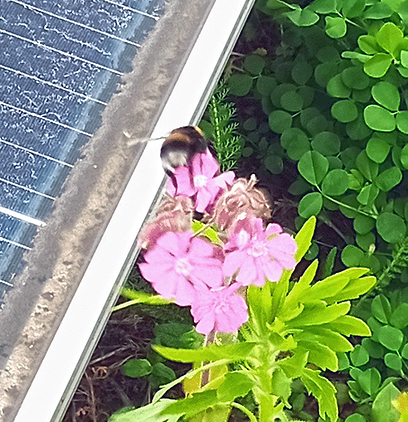
Silene dioica a.k.a. red campion
Similar varieties: White campion (Silene latifolia).
Accolades: RHS Plants for Pollinators.
Description: Red Campion is a biennial or perennial plant with rose-red flowers. It is dioecious, meaning male and female flowers grow on separate plants. It self-seeds easily, making it well suited to biosolar green roofs.
Family: Caryophyllaceae.
Position: Full sun to partial shade.
Soil conditions: Well drained – ideal for green roof and biosolar substrates.
Growth on biosolar roofs: Grows to around 30cm–60cm.
Flowering period: April to September.
Why it works well on biosolar roofs: Red Campion is a woodland edge plant, which means it adapts well to growing between solar panels on biosolar roofs. Its long flowering season provides an important food source for pollinators, including long-tongued bumblebees, hoverflies, and moths such as Lychnis and Marbled Clover.
Maintenance: Cut back in autumn. Trim if plants begin to shade the solar panels.
Image: Bee foraging on Silene dioica on a biosolar roof in Essex, UK. A. Favell, P&P.
Anthyllis vulneraria a.k.a. kidney vetch

Accolades: RHS Plants for Pollinators.
Description: Kidney Vetch is a perennial plant that often grows low and spreading. It has paired heads of yellow flowers with a hairy outer casing. It flowers from June to September and produces pea-like seed pods. It is very drought tolerant, making it ideal for biosolar roofs.
Family: Fabaceae.
Position: Full sun to partial shade.
Soil conditions: Well drained – well suited to green roof and biosolar substrates.
Growth on biosolar roofs: Usually grows to 20–30cm, with a maximum height of around 60cm.
Why it works well on biosolar roofs: Kidney Vetch is highly attractive to pollinators, including the Wool Carder Bee, and is a vital food source for the Small Blue Butterfly (Cupido minimus). Like many legumes, it improves biosolar roof substrates by fixing nitrogen in the soil through root nodules. It also has a long history of traditional medicinal use.
Maintenance: Cut back in autumn. Trim if plants begin to shade the solar panels.
Image: A foraging bee on Anthyllis vulneraria on a biosolar roof in Essex, UK. By A. Favell, P&P.
Lotus corniculatus a.k.a. bird’s-foot trefoil

Similar varieties: Greater Bird’s-foot Trefoil (Lotus pedunculatus) and Narrow-leaved Bird’s-foot Trefoil (Lotus tenuis).
Accolades: RHS Plants for Pollinators.
Description: Bird’s-foot Trefoil is a low-growing plant with leaves arranged in groups of five. It flowers from May to September, producing yellow, pea-shaped flowers that open from red and yellow buds. The seed heads are shaped like a bird’s foot, which gives the plant its name.
Family: Fabaceae.
Position: Full sun.
Soil conditions: Well drained – well suited to green roof and biosolar substrates.
Growth on biosolar roofs: Typically grows to around 20cm.
Why it works well on biosolar roofs: The bright yellow flowers are highly attractive to pollinators, including the Red-tailed Bumblebee. Bird’s-foot Trefoil is also an important food plant for caterpillars of the Common Blue butterfly, as well as priority species such as the Silver-studded Blue and Wood White. Its low growth makes it ideal for planting between solar panels on biosolar roofs.
Maintenance: Cut back in autumn. Trim if plants begin to shade the solar panels.
Image: Lotus corniculatus (Bird’s-foot Trefoil) in Perthshire, Scotland. By Judy Gallagher.
Trifolium pratense a.k.a. red clover

Similar varieties: White Clover (Trifolium repens).
Accolades: RHS Plants for Pollinators.
Description: Red Clover is a low-growing, spreading perennial with three-part leaves that often show pale markings. It produces pink to red flower heads from May to September. Its strong, hardy nature makes it well suited to biosolar roof environments.
Family: Fabaceae.
Position: Full sun.
Soil conditions: Well drained – ideal for green roof and biosolar substrates.
Growth on biosolar roofs: Grows up to around 30cm.
Why it works well on biosolar roofs: Red Clover is rich in nectar and highly attractive to pollinators, including the Common Carder Bee, Brown-banded Carder Bee, Honeybee, and Red-tailed Bumblebee. As a legume, it improves biosolar roof substrates by fixing nitrogen in the soil, helping support healthy plant communities around solar panels.
Maintenance: Cut back in autumn. Trim if plants begin to shade the solar panels.
Image: Trifolium pratense (Red Clover) on a biosolar roof in London, UK. A. Favell, P&P.
Sanguisorba minor a.k.a. salad burnet

Similar varieties: Great Burnet (Sanguisorba officinalis).
Accolades: RHS Plants for Pollinators.
Description: Salad Burnet is a hardy perennial herb. It grows low to the ground in a rosette shape, with leaves made up of multiple paired leaflets. Small, round reddish flower heads grow on taller stems above the foliage. It copes well in exposed roof environments, making it suitable for biosolar systems.
Family: Rosaceae.
Position: Full sun.
Soil conditions: Well drained – ideal for green roof and biosolar substrates.
Growth on biosolar roofs: Typically grows between 15–40cm.
Why it works well on biosolar roofs: Salad Burnet attracts butterflies and bees with its nectar-rich flowers, while its seeds provide food for birds. It adds biodiversity value to biosolar roofs without becoming too tall around solar panels. The leaves also smell and taste like cucumber and have been used traditionally as a herbal remedy.
Maintenance: Cut back in autumn. Trim if plants begin to shade the solar panels.
Image: Sanguisorba minor (Salad Burnet) on a biosolar roof in Essex, UK. By A. Favell, P&P.
Prunella vulgaris a.k.a. self-heal, heal-all

Accolades: RHS Plants for Pollinators.
Description: Selfheal is a low-growing, creeping semi-evergreen perennial. It produces bluish to violet flowers from June to October. Its spreading habit makes it well suited to biosolar roofs where plants need to stay compact around solar panels.
Family: Lamiaceae.
Position: Full sun to partial shade.
Soil conditions: Well drained – ideal for green roof and biosolar substrates.
Growth on biosolar roofs: Typically grows to around 20cm.
Why it works well on biosolar roofs: Like many plants in the Lamiaceae family, Selfheal is a valuable nectar source for bees and wasps. Small hairs inside the flower help stop tiny insects from stealing nectar, which supports key pollinators. Its low growth makes it ideal between solar panels on biosolar systems. Traditionally, it has been used as a herbal remedy in both Western and Chinese medicine, giving it the names “self-heal” and “heal-all.”
Maintenance: Cut back in autumn. Trim if plants begin to shade the solar panels.
Image: Bee foraging on Prunella vulgaris. By AnRo0002.
Achillea millefolium a.k.a. common yarrow

Accolades: RHS Plants for Pollinators.
Description: Yarrow is a hardy perennial with long, fern-like leaves that grow in a spiral pattern from the stem. From mid-summer, it produces dense clusters of small white flower heads on top of tall stems. It adds height and seasonal interest to biosolar roofs.
Family: Asteraceae.
Position: Full sun or partial shade.
Soil conditions: Moist but well drained – suitable for well-designed green roof and biosolar substrates.
Growth on biosolar roofs: Can grow up to 50cm.
Flowering period: July to October.
Why it works well on biosolar roofs: Yarrow is one of the best nectar plants for pollinators. It supports flies, short-tongued bees, butterflies, beetles, and is also a food source for the larvae of many moths, especially Pug moth species. When carefully positioned around solar panels, it boosts biodiversity without affecting system performance. Traditionally, it was used to treat wounds, and its name comes from the Greek hero Achilles, who used it to heal soldiers.
Maintenance: Cut back in autumn. Trim if plants begin to shade the solar panels.
Image: Achillea millefolium on a biosolar roof in London, UK. A. Favell, P&P.
Centaurea cyanus a.k.a. cornflower

Accolades: RHS Plants for Pollinators.
Description: Cornflower is a deciduous annual plant with narrow, lance-shaped leaves. It produces deep blue flower heads around 3cm wide throughout the summer. Its natural toughness makes it well suited to biosolar and living roof environments.
Family: Asteraceae.
Position: Full sun.
Soil conditions: Well drained – thrives in green roof and biosolar substrates. It naturally grows on disturbed and scrub land, which makes it ideal for roof conditions.
Growth on biosolar roofs: Can grow up to 75cm.
Flowering period: June to August.
Why it works well on biosolar roofs: Cornflower nectar has a very high sugar content, making it highly attractive to bees, wasps, and other pollinators. Its seeds also provide food for birds such as the European Goldfinch. Once common in cornfields, it declined due to modern farming and is now listed as a priority species under the UK Post-2010 Biodiversity Framework. Adding it to biosolar roofs helps support biodiversity while working alongside solar panels.
Maintenance: Cut back in autumn. Trim if plants begin to shade the solar panels.
Image: Centaurea cyanus on a biosolar roof in Essex, UK. A. Favell, P&P.
Echium vulgare a.k.a. viper’s bugloss

Accolades: RHS Plants for Pollinators.
Description: Viper’s Bugloss is a biennial plant with narrow, bristly leaves and spotted stems. From May onwards, it produces tall stems covered in bell-shaped violet-blue flowers. It is drought tolerant, making it well suited to exposed biosolar roof environments.
Family: Boraginaceae.
Position: Full sun.
Soil conditions: Well drained – ideal for green roof and biosolar substrates. It naturally grows on disturbed land and sand dunes, which makes it a strong choice for living and biosolar roofs.
Growth on biosolar roofs: Typically grows between 30–70cm.
Flowering period: May to September.
Why it works well on biosolar roofs: Viper’s Bugloss produces sugar-rich nectar throughout the day, attracting a wide range of pollinators. Its deep tubular flowers are especially suited to long-tongued species such as Buff-tailed and Red-tailed Bumblebees, Red Mason Bees, and Honeybees. It also supports butterflies like the Large Skipper and Painted Lady, as well as Burnet moths. It self-seeds easily in dry conditions after flowering in its second year, helping biosolar roofs stay biodiverse over time.
Maintenance: Cut back in autumn. Trim if plants begin to shade the solar panels.
Image: Echium vulgare on a biosolar roof in Essex, London, UK. A. Favell, P&P.
Galium verum a.k.a. lady’s bedstraw

Accolades: RHS Plants for Pollinators.
Description: Lady’s Bedstraw is a low-growing, carpeting perennial. It produces clusters of small, four-petalled golden-yellow flowers from mid-summer. It spreads easily by layering and self-seeding, helping it establish well on biosolar roofs.
Family: Rubiaceae.
Position: Full sun or partial shade.
Soil conditions: Well drained – can even tolerate dry, arid conditions. Ideal for green roof and biosolar substrates.
Growth on biosolar roofs: Typically grows between 20–30cm.
Flowering period: June to September.
Why it works well on biosolar roofs: Its honey-scented flowers attract bees and butterflies, supporting pollinator activity around solar panels. It is also an important food plant for caterpillars of several hawk moths, including the Hummingbird Hawk-moth, Small Elephant Hawk-moth, and Bedstraw Hawk-moth, as well as moths like the Ruddy Carpet, Royal Mantle, and Common Carpet. Its spreading habit makes it great for filling gaps on biosolar roofs while maintaining biodiversity. Traditionally, it was used to scent mattresses (as a natural flea repellent) and to help coagulate milk for cheese-making.
Maintenance: Cut back in autumn. Trim if plants begin to shade the solar panels.
Image Galium verum. By Andreas Rockstein.
Leucanthemum vulgare a.k.a. oxeye daisy

Accolades: RHS Plants for Pollinators.
Description: Oxeye Daisy is a deciduous, clump-forming perennial that spreads through underground rhizomes. It produces large white, daisy-like flowers on single tall stems, with long, toothed leaves. Its strong growth makes it suitable for well-designed biosolar roof systems.
Family: Asteraceae.
Position: Full sun or partial shade.
Soil conditions: Well drained – suitable for green roof and biosolar substrates.
Growth on biosolar roofs: Can grow up to 60cm.
Flowering period: June to September.
Why it works well on biosolar roofs: Oxeye Daisy provides a long-lasting and generous source of nectar, supporting short-tongued bees, butterflies, hoverflies, and beetles, including snout weevils and longhorn beetles. When positioned correctly around solar panels, it adds strong visual impact while boosting biodiversity on biosolar roofs.
Maintenance: Cut back in autumn. Trim if plants begin to shade the solar panels.
Image: Leucanthemum vulgare on a biosolar roof in Wimbledon, London. By R. Watson, P&P.
Plants to avoid or remove from biosolar roofs

Avoid tall or bushy plants.
They can shade solar panels and reduce performance. Stick to small annuals, perennials, and bulbs. Most shrubs are not suitable. Some taller plants like Centaurea cyanus (Cornflower) and Leucanthemum vulgare (Oxeye Daisy) are acceptable if carefully positioned, as their biodiversity value is very high.
Avoid moisture-loving plants.
Biosolar roofs are well drained and can become dry. Choose species that naturally grow in disturbed land, scrubland, coastal areas, or sand dunes. Many ferns are not suitable.
Avoid climbing plants.
Climbers can interfere with panels and electrics. Do not use ivy, clematis, blackberries, honeysuckle, or clambering vetches such as Vicia cracca, Vicia sepium, and Vicia sativa.
Image:
Vicia cracca (Tufted Vetch) showing its climbing habit. Photo by Thibault Lefort.
Plants to avoid or remove from biosolar roofs (cont.)

Avoid high-maintenance plants.
Most biosolar roofs are only maintained twice a year, so plants must cope with minimal care.
Avoid invasive or dominant species.
Spreading plants are great for coverage, but not if they take over. Sonchus oleraceus (Common Sowthistle), for example, supports wildlife but can grow up to 1.5m tall and quickly dominate a biosolar roof, shading solar panels if left unchecked.
Grasses:
Some designers avoid grasses completely on living roofs. However, this can be too extreme. Many native grasses provide value for invertebrates, pollinators, and birds when properly managed within a biosolar system.
Avoid too much of one species.
Sedums work well on biosolar roofs and provide nectar in June and July, but biodiversity matters. Buglife recommends that no more than 30% of the roof should be Sedum.
Image:
At 1.5m, Sonchus oleraceus (Common Sowthistle) can tower over solar panels and dominate if allowed to seed. Photo taken during a maintenance visit to a biosolar roof in Essex, London, by A. Favell, P&P.
Plants to avoid or remove from biosolar roofs (cont.)

No matter how high or urban a biosolar roof is, plants will naturally colonise through wind, birds, and even squirrels.
Remove saplings and shrubs.
Common self-seeders include Buddleja davidii, Pussy Willow (Salix caprea / Salix cinerea), as well as Ash, Sycamore, Elder, and Birch. These can quickly grow too large for a biosolar roof.
Remove invasive or unsuitable weeds.
Even native species like Urtica dioica (Common Nettle) and Sonchus oleraceus (Common Sowthistle) are too tall (1–1.5m) and spread aggressively. Fast-spreading grasses such as Elymus repens (Couch Grass) can also outcompete smaller wildflowers.
Keep firebreaks and gutters clear.
Remove any vegetation encroaching on firebreaks, drainage outlets, or gutters.
Protect solar performance.
Remove unsuitable plants and trim back valuable species if they begin shading the panels.
Image:
Young Buddleja davidii saplings removed during a maintenance visit to a biosolar roof in London. In the right conditions, Buddleja can grow up to 3m tall. Photo by A. Favell, P&P.
This guide was put together with help from Dr Kevin Walker, Botanical Society of Britain and Ireland (BSBI); Rachel Richards, Buglife; Leif Bersweden, botanist; Donald MacIntyre, Emorsgate Seeds; Georgia Gilbert, John Chambers Wildflower Seed; Kathryn Pugh, Landlife Wildflowers; Stephen Dixon, ecologist.
Other sources include: Wildlife Trust Wildflower database; NatureSpot database; RHS plant database; RHS plants for pollinators; Plantlife plant database; Food for Pollinators: Quantifying the Nectar and Pollen Resources of Urban Flower Meadows by Hicks et al, 2016.
WHERE TO GO NEXT
To understand how biosolar compares with other combined roof systems, continue to Biosolar vs Green Roof Solar.
If you’d like to explore what a biosolar roof can achieve in terms of energy performance, biodiversity value, and planning outcomes, visit Key Benefits.
For policy drivers and regulatory context, the Biosolar and Planning / Policy page provides a concise overview of current UK guidance.
If you’re seeking a specialist contractor to deliver a biosolar roof system visit PV Plus