.png)
LEARNING HUB
Types of
Green Roofs
Compare extensive, semi-intensive, intensive, biodiverse, brown and blue-green roof systems and understand which green roof types work best with biosolar PV.
What Makes One Green Roof Type Different From Another?
Green roofs vary in the depth of their growing medium, the vegetation they can support, their structural load and the level of maintenance they require.
Choosing the right type depends on the building, available roof capacity, project objectives and how the green roof will work alongside solar PV.
Substrate Depth↑ → Weight↑ → Plant Variety↑ → Maintenance ↑
In Simple Terms:
As green roofs become deeper and support more substantial planting, they will generally become heavier and require more maintenance.
Each type offers different advantages, from lightweight low-maintenance planting to biodiverse habitats and accessible roof gardens.
Main Green Roof Types
01
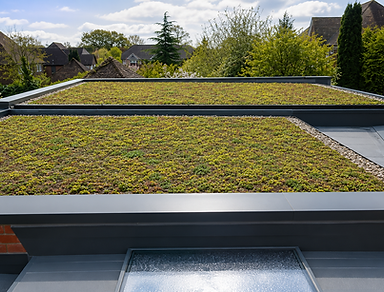
Extensive Green Roof
Extensive green roofs use relatively shallow growing media and low-growing vegetation. They are designed to provide reliable green coverage without requiring the deeper build-up or maintenance associated with more intensive systems.
Their lower weight and simpler planting make them particularly useful on commercial roofs where structural capacity, maintenance and available roof space need to be carefully managed.
Typical Planting
-
Sedums and succulents
-
Mosses and low-growing herbs
-
Hardy grasses and bulbs
What It's Like
-
Relatively lightweight build-up
-
Lower maintenance requirements
-
Designed for resilient planting
Biosolar Fit
-
Commonly compatible with solar PV
-
Leaves scope for practical access
-
Suitable for many commercial roofs
02
Semi-Intensive Green Roof
Semi-intensive roofs sit between extensive and intensive systems. They use deeper growing media and support a broader range of plants while remaining less demanding than a fully landscaped intensive roof.
They can provide a useful balance between structural load, biodiversity, visual interest and maintenance, making them particularly attractive where stronger ecological outcomes are wanted.
Typical Planting
-
Wildflowers and flowering herbs
-
Grasses and perennial plants
-
Smaller shrubs where appropriate
What It's Like
-
Moderate growing-medium depth
-
Moderate maintenance requirements
-
Greater planting diversity
Biosolar Fit
-
Works well with coordinated PV layouts
-
Supports stronger biodiversity objectives
-
Offers varied planting around panels

03
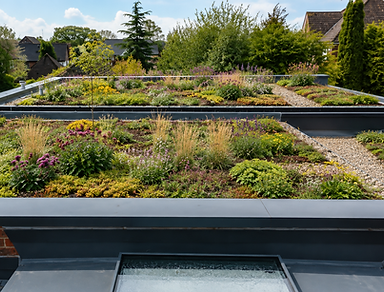
Intensive Green Roof
Intensive green roofs use deeper growing media and can support substantial planting similar to a traditional landscaped garden. Some are designed as accessible spaces with paths, seating or other landscape features.
Their greater weight and maintenance needs mean structural capacity, irrigation, access and long-term management must be considered carefully when combining them with solar PV.
Typical Planting
-
Perennials and ornamental grasses
-
Shrubs and substantial vegetation
-
Lawns or small trees where suitable
What It's Like
-
Deeper and heavier roof build-up
-
Higher maintenance requirements
-
Can create usable landscaped space
Biosolar Fit
-
Possible where structure allows
-
Requires careful PV coordination
-
Suitable for high-value roof spaces
Specialist Ecological Approaches

Biodiverse Roof
Biodiverse roofs are designed specifically to create varied habitat and support wildlife. They may use different substrate depths, native or habitat-focused planting and features that increase ecological value.
Typical Features
-
Native and wildflower planting
-
Varied substrate depths
-
Logs, stones or habitat features
Ecological Purpose
Create a more diverse rooftop habitat for plants, insects, pollinators and other wildlife.
Brown Roof
Brown roofs are inspired by brownfield habitats and often use low-nutrient mineral materials that allow vegetation to establish more naturally over time.
Typical Features
-
Recycled or mineral materials
-
Stones, sand and uneven surfaces
-
Natural vegetation colonisation
Ecological Purpose
Recreate valuable brownfield-style habitats and provide shelter and nesting opportunities for wildlife.

What About Blue Roofs?
A green roof and a blue roof both manage rainwater, but they do it for different reasons.

How a Green Roof Manages Water
A normal green roof already retains some rainfall within its vegetation, growing medium and drainage or water-retention layer. Some of this water is used by the plants or lost through evaporation, while excess water eventually drains towards the roof outlets.
The drainage board therefore helps manage water within the green roof build-up and safely move excess water away. It can delay runoff, but once the green roof becomes saturated it does not normally control the exact rate at which water leaves the roof.
What Makes a Blue Roof Different?
A blue roof is specifically designed to temporarily hold stormwater and release it at a controlled rate.
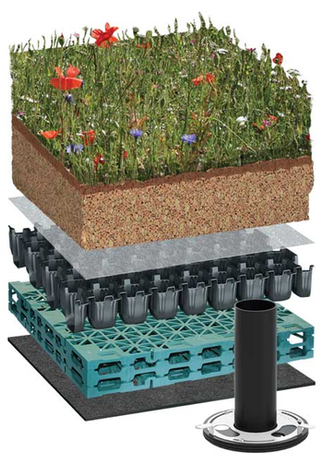
It creates additional storage capacity at roof level, often using a dedicated attenuation layer or cellular void above the waterproofing. The large cellular layer shown in the image is an example of this type of water-storage zone.
A flow-control outlet then restricts how quickly the stored water can leave the roof.
Store Water → Hold It Temporarily → Release It at a Controlled Rate

Blue Roof
Primarily provides engineered stormwater attenuation by storing water and controlling its discharge.

Green Roof
Primarily provides vegetation and green infrastructure while naturally retaining and delaying some rainfall.
Blue-Green Roof Build-Up
A blue-green roof combines a green roof system with a blue-roof attenuation layer to provide both natural and engineered rainwater management.
-
Vegetation
-
Growing medium (substrate)
-
Filter layer
-
Drainage / water-retention layer
-
Blue-roof attenuation layer (cellular storage)
-
Waterproofing membrane
-
Flow-control outlet
What Is a Blue-Green Roof?
A blue-green roof places a green roof above a dedicated blue-roof attenuation system.
Rainfall first passes through the vegetation and substrate before excess water enters the additional storage layer below.
This allows one roof to provide:
-
Vegetation and biodiversity
-
Natural rainfall retention
-
Additional stormwater storage
-
Controlled water discharge
Solar PV can then be coordinated above the planting to create a biosolar blue-green roof, combining renewable energy, green infrastructure and rainwater management within one roof system.
Which Green Roof Works Best With Biosolar?
There is no single green roof type that is best for every biosolar project. The most suitable option depends on structural capacity, biodiversity objectives, maintenance requirements and the intended use of the roof.
Extensive
Often a strong option for commercial and industrial roofs where lower weight, simpler maintenance and efficient use of roof space are priorities.
Best suited to:
Projects needing a practical, relatively lightweight green roof alongside solar PV.
Semi-Intensive / Biodiverse
A strong option where the project wants greater planting diversity and ecological value while maintaining a manageable roof build-up.
Best suited to:
Projects balancing solar generation with stronger biodiversity and habitat objectives.
Intensive
Best considered where the structure can support a heavier build-up and the roof is intended to provide substantial landscaping or usable space.
Best suited to:
Projects where the roof forms an important architectural or accessible landscape feature.
WHERE TO GO NEXT
To understand how biosolar compares with other combined roof systems, continue to Biosolar vs Green Roof Solar.
If you’d like to explore what a biosolar roof can achieve in terms of energy performance, biodiversity value, and planning outcomes, visit Key Benefits.
For policy drivers and regulatory context, the Biosolar and Planning / Policy page provides a concise overview of current UK guidance.
If you’re seeking a specialist contractor to deliver a biosolar roof system visit PV Plus